
 2.svg)



Measure light intensity: how many lux does your plant need?
Measure light intensity at leaf height, right where your plant stands. Here you can read how many lux your plant needs, how to read a light meter and why your phone only gives a rough estimate.
Why it pays to measure light intensity instead of guessing
If you measure light intensity, you get a far more reliable answer than your eyes can give. Your eyes adapt, so a room feels bright while a plant gets too little light. Indoors, light also drops quickly. According to Mississippi State University, light intensity can fall from more than 10,000 to about 1,000 lux within a few metres of the window. A spot one metre further away may therefore need a completely different plant.
A light meter for plants shows within seconds how much light really reaches a spot. That way you choose the right plant for the spot, or the right spot for the plant. You also see straight away whether a grow light is needed. A plant that gets too little light becomes long and leggy, gets pale leaves and does not flower (University of Minnesota).

How many lux do plants need?
Houseplants are divided into three light groups. The University of Minnesota gives the values in foot-candles. We converted them to lux, the unit most light meters show (1 foot-candle is 10.76 lux).
| Light group | Lux | PPFD | Examples |
|---|---|---|---|
| Low light | 540 – 2,700 | 50–150 | ZZ plant, snake plant, pothos |
| Medium light | 2,700 – 10,800 | 150–250 | Monstera, ficus, spider plant |
| High light | more than 10,800 | 250–450 | Cacti, succulents, herbs |
How many lux is daylight?
Outdoors in full sun you measure more than 100,000 lux. Full sun gives about 2,000 µmol/m²/s (Virginia Tech), and in daylight 1 µmol/m²/s equals roughly 54 lux (Apogee Instruments). Behind glass and away from the window, only part of that remains. That is why a meter with a range up to 200,000 lux, such as our digital light meter, is more than enough indoors and outdoors.
Measure light intensity: how to read the result by type of meter
Not every meter shows lux. So first check which type you have:
- Lux light meter, such as the digital light meter: compare the number with the table above. With the UNIT button you can also switch to foot-candles.
- Plant sensor with app, such as the 4 in 1 Bluetooth Plant Care Monitor: the free Flower Care app shows light intensity on your phone, together with moisture, temperature and nutrients.
- Soil tester with a light scale, such as the 4-in-1 soil tester and the 6-in-1 digital tester (9 steps from weak to strong): these give an indication, not lux. Use the scale from the manual, which you can find under download manuals.
- Phone app: handy for a first impression, but less accurate. Read more about this in the questions below.
How to measure light intensity in 4 steps
- Measure at leaf height, exactly where the plant stands or will stand. Point the sensor towards the window or the lamp.
- Measure at different times, for example in the morning, around midday and late in the afternoon. That way you see how the light changes during the day.
- Measure on a sunny and on a cloudy day. One reading says little, because the average is what counts.
- Measure again when the seasons change. Trees in leaf block light in summer and let more through in winter (University of Illinois).
Light meter, plant sensor or soil tester: which suits you?
| Light meter | Plant sensor | Soil tester | |
|---|---|---|---|
| Result | Number in lux on the display | Values in the app on your phone | Indication from weak to strong |
| Also measures | Temperature | Moisture, temperature, nutrients | pH, moisture, temperature |
| Stays with the plant | No, you measure wherever you like | Yes | No |
| Best for | Choosing a spot, setting up a grow light | Following one plant continuously | A quick all-round check |
| Example | Digital light meter | 4 in 1 Bluetooth Plant Care Monitor | 4-in-1 soil tester, 6-in-1 tester |
If you mainly want to know whether a spot gets enough light, choose the digital light meter. It shows lux with a range up to 200,000 lux. If you also want to follow moisture and nutrients, the 4 in 1 Bluetooth Plant Care Monitor is more convenient, because it simply stays with the plant.
Our recommendations to measure light intensity
-
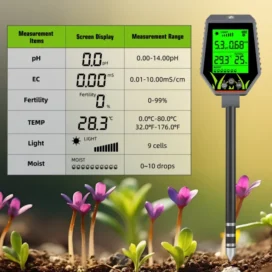 6-in-1 Digital tester for soil and liquids – pH, EC, light, moisture, fertiliser and temperature€89,90
-
 4-in-1 plant soil tester: measures pH value, humidity, temperature and light intensityOriginal price was: €34,90.€24,90Current price is: €24,90.
-
 Digital Light Meter€22,90
-
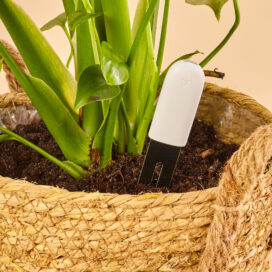 4 in 1 Bluetooth Plant Care Monitor€35,90
Frequently asked questions about measuring light intensity
Lux and light requirements
How many lux do plants need?
It depends on the plant. Low-light plants manage with 540 to 2,700 lux, medium-light plants need 2,700 to 10,800 lux and high-light plants want more than 10,800 lux (University of Minnesota). Below about 540 lux, hardly any plant survives for long.
How much light does a monstera need?
A monstera is a medium-light plant: between 2,700 and 10,800 lux. A spot close to an east or west window therefore usually works well. Strong midday sun behind glass, however, can scorch the leaves.
How many lux is sunlight?
Outdoors in full sun you measure more than 100,000 lux. Indoors it is much less, because glass, curtains and the distance from the window block light. A few metres from the window you often measure only a tenth of the value right next to the glass.
How do I know if my plant gets too little or too much light?
With too little light, leaves turn pale or yellow, stems become long and thin and the leaves grow further apart. Variegated leaves may also turn completely green, and flowering plants form no buds. Too much light shows as scorched or bleached patches on the leaves (University of Minnesota).
Measuring with a phone or a light meter
Can I use a light meter app for plants?
For a first impression, yes, but do not expect an exact number. In one test, a phone’s light sensor was up to almost 40% off without calibration, and in low light (below 100 lux) even more than 60%. A separate light sensor was only 2.7% off in the same test (Gutierrez-Martinez et al., 2017). If you really want to choose a spot, use a light meter.
What is the difference between lux and PPFD?
Lux measures how bright light looks to the human eye. PPFD, on the other hand, counts the light particles a plant uses for photosynthesis, in µmol per square metre per second. For research and growing, PPFD is therefore the better measure (Virginia Tech). To compare spots in your home in daylight, lux is fine.
How do I convert lux to PPFD?
In daylight, divide the number of lux by 54. So 10,800 lux is roughly 200 µmol/m²/s. Other lamps use a different factor, for example 74 for fluorescent light (Apogee Instruments). There is no fixed factor for LED grow lights, so use the PPFD stated by the manufacturer instead.
Grow lights
How many hours of light do plants need under a grow light?
Foliage plants need 12 to 14 hours of light a day, flowering plants 14 to 16 hours and seedlings 16 to 18 hours (University of Minnesota). Use a timer, so the plant also gets a rest every night.
How far should a grow light be from plants?
As a guideline, hang the lamp 30 to 60 cm (12 to 24 inches) above foliage plants, 15 to 30 cm (6 to 12 inches) above flowering plants, herbs and lettuce, and 10 to 15 cm (4 to 6 inches) above seedlings (University of Minnesota). Then measure at leaf height and adjust the lamp until the value suits your plant.
Not enough light coming in? Then take a look at our grow lights. And if you also want to know when to water, read how to measure soil moisture.
Not sure which light meter suits you?
Send us a photo of the spot and the plant. We are happy to help you choose the right meter for free, or a grow light if the light falls short.
Sources
- University of Minnesota Extension, Light requirements for houseplants: light groups in foot-candles and PPFD
- University of Minnesota Extension, Lighting for indoor plants: signs of too little or too much light, hours and distance of grow lights
- Mississippi State University Extension, Care and Selection of Indoor Plants: drop in light near the window and the lower limit for plants
- University of Illinois Extension, Houseplants: Lighting: influence of the seasons
- Stallknecht (2025), Calculating and Using Daily Light Integral, Virginia Cooperative Extension: full sun and PPFD as the measure for plants
- Apogee Instruments, Conversion PPFD to lux: conversion factors per light source
- Gutierrez-Martinez et al. (2017), Smartphones as a Light Measurement Tool, Applied Sciences: accuracy of phones
Last updated: 27 October 2026