
 2.svg)



How to test soil pH: how acidic is your soil?
Test soil pH in moist soil at root depth. Here you’ll find the ideal pH for vegetables, lawns and potting mix, how to measure accurately, and how to raise or lower soil pH.
Why test soil pH?
When you test soil pH, you find out how acidic or alkaline your soil is. That matters, because pH controls how well a plant can take up nutrients. The pH scale runs from 0 to 14: below 7 is acidic, 7 is neutral and above 7 is alkaline. However, you can’t see pH by looking at soil, so you need to measure it.
In addition, most vegetables and flowers grow best in slightly acidic soil, between 5.8 and 6.3. If your pH is between 6.0 and 7.0, you usually don’t need to change anything (University of Delaware). That’s why you test first, and only then add lime or sulfur.

Ideal soil pH: table by plant group
| Where | Ideal pH | Source |
|---|---|---|
| Vegetables and flowers | 5.8 – 6.3 | University of Delaware |
| Lawn | 6.0 – 7.0 | University of Delaware |
| Potting mix without garden soil | 5.5 – 6.0 | University of Connecticut |
| Blueberries | 4.5 – 5.0 | University of Delaware |
| Rhododendron and azalea | below 5.5 | University of Delaware |
| Hydrangea blue / pink | 5.0 – 5.5 / 6.0 and up | NC State Extension |
How to test soil pH in 4 steps
- Sample at the right depth. For a lawn, sample to 7.5 cm (3 in); for vegetable gardens and beds, 15–20 cm (6–8 in) (Purdue University). Take soil from several spots and mix it: 4 to 6 spots in a border, 10 to 15 in a large garden.
- Prepare the soil. First remove stones and plant debris, then crumble the soil and wet it with distilled water until it is muddy (Rapitest 1845 manual).
- Measure as the manual says. Polish the probe, push it straight into the soil without forcing it, twist it a few times and read after 60 seconds. With a test kit, follow the colour chart.
- Test again in another spot and take the average. Retest a normal garden every 3 to 5 years, and more often for acid-loving plants (Purdue University).
Want to measure water or nutrient solution instead? Read how to measure the pH of water. You can find the manuals for our meters under download manuals.
Test soil pH: probe meter, test kit or digital meter?
| Probe meter | Colour test kit | Digital meter with electrode | |
|---|---|---|---|
| How | Probe in wet soil, read directly | Soil sample with water and reagent, compare colour | Electrode in the soil, value on screen or app |
| Accuracy | Indication | About 0.2 pH from the lab | About 0.1 – 0.2 pH |
| Also measures | Often moisture | Nitrogen, phosphorus, potassium | Temperature, stored readings |
| Best for | Quick spot check | Vegetable garden and lawn, with NPK | Precise measuring and logging |
| Example | Digital soil pH meter, pH/moisture meter | Soil test kit N, P, K, pH | Bluetooth soil pH meter |
In an American study, a hand meter with an electrode and a colour test kit stayed within about 0.2 pH of the laboratory. A simple pH probe, however, read 6.0 on three different soils (Journal of Extension, 2001). A probe meter is therefore mainly useful for a quick indication. Before you add lime or sulfur, check the value with a soil test kit or a digital pH meter with electrode, or have a laboratory test it.
How to raise or lower soil pH
Raise soil pH: add lime
If the pH is too low, add lime: calcitic lime, or dolomitic lime if the soil also needs magnesium. Before planting, work the lime into the top 15 to 20 cm (6–8 in) of soil. On a lawn or an existing bed, on the other hand, spread it on top and water it in. If you need a lot of lime, split it over several applications 3 to 4 months apart. A laboratory soil test tells you exactly how much lime you need (University of Delaware).
Lower soil pH: elemental sulfur
If the pH is too high, use elemental sulfur. Soil bacteria turn the sulfur into acid. However, this works slowly and the effect is temporary, so retest after 4 to 6 months. Don’t take the pH below 5.0, except for blueberries. Gypsum and Epsom salt do not lower pH (University of Delaware). Coffee grounds barely help either, because brewed grounds have a pH of 6.5 to 6.8 (Oregon State University).
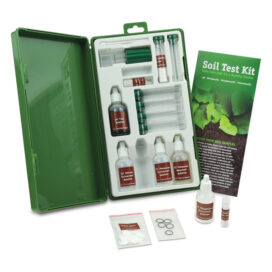
Our picks to test soil pH



Frequently asked questions about testing soil pH
Ideal pH values
What is a good soil pH?
Most vegetable gardens and flowers do best between pH 5.8 and 6.3. A lawn grows best between 6.0 and 7.0. If your pH is between 6.0 and 7.0, you usually don’t need to change anything (University of Delaware).
What is the ideal soil pH for a lawn?
Grass grows best at a pH between 6.0 and 7.0 (University of Delaware). If the pH is lower, you can add lime. If it is higher, you usually don’t need to do anything for grass, as long as the lawn is healthy.
What pH should potting mix have?
Potting mix without garden soil does best between pH 5.5 and 6.0. If the mix contains 20 percent or more field soil, the optimum is 6.2 to 6.5 (University of Connecticut).
What pH does a hydrangea need for blue flowers?
A bigleaf hydrangea (Hydrangea macrophylla) flowers blue at pH 5.0 to 5.5 and pink at pH 6 or higher. In acidic soil the plant can take up aluminium, which turns the flowers blue (NC State Extension). White hydrangeas, such as panicle hydrangeas, don’t change colour.
Testing and accuracy
How do you test soil pH at home?
Remove the top 5 cm (2 in) of soil, crumble the soil below and wet it with distilled water until muddy. Push the clean probe straight into the soil, twist it a few times and read after 60 seconds. Then test again in another spot (Rapitest 1845 manual).
Are soil pH meters accurate?
It depends on the type. In an American study, a hand meter with an electrode and a colour test kit stayed within about 0.2 pH of the laboratory. A simple pH probe read 6.0 on three different soils (Journal of Extension, 2001). A probe meter gives an indication; for a precise value use a test kit, a calibrated meter or a laboratory.
How do I know if my soil is acidic?
Only by testing. A pH below 7 is acidic, above 7 is alkaline. For most plants a slightly acidic soil between 6.0 and 7.0 is fine, so you don’t need to change it (University of Delaware).
Adjusting pH
How do you raise soil pH?
Add lime: calcitic lime, or dolomitic lime if the soil also needs magnesium. Work it into the top 15 to 20 cm before planting. On a lawn, spread it and water it in. If you need a lot, split it over several applications 3 to 4 months apart (University of Delaware).
How do you lower soil pH?
Use elemental sulfur: soil bacteria convert it into acid. It works slowly and temporarily, so retest after 4 to 6 months. Don’t go below pH 5.0, except for blueberries. Gypsum and Epsom salt don’t lower pH (University of Delaware). Coffee grounds have a pH of 6.5 to 6.8 and barely acidify soil (Oregon State University).
How often should you test soil pH?
Every 3 to 5 years is enough for a normal garden. Test more often for plants that need a specific pH, such as blueberries or blue hydrangeas (Purdue University). If you added sulfur, retest after 4 to 6 months (University of Delaware).
Measuring moisture or fertiliser too? Read how to measure soil moisture and all about measuring fertiliser.
Not sure which pH meter suits you?
Tell us what you want to measure: the vegetable garden, the lawn or potting mix. We’ll help you choose the right meter or test kit, free of charge.
Sources
- Shober & Denny (2025), Delaware Gardener’s Guide to Soil pH, University of Delaware: pH by plant group, liming and sulfur
- Pettinelli & McAvoy, Soil testing for greenhouse media, University of Connecticut: pH of potting mix
- Strickland (2025), How to Change Hydrangea Color, NC State Extension: pH for blue and pink hydrangeas
- Daniel, Lerner & Ackerson, Collecting Soil Samples for Testing (HO-71), Purdue University: sampling depth and how often to test
- Journal of Extension (2001), Tools of the Trade 4TOT3: accuracy of pH meters and test kits
- Pokorny (2023), Coffee grounds boost soil health, Oregon State University: pH of coffee grounds
- Luster Leaf, Rapitest Soil pH Meter No. 1845: measuring method
Last updated: 9 November 2026