
 2.svg)



NPK soil test: which nutrients is your soil missing?
An NPK soil test tells you whether there is enough nitrogen, phosphorus and potassium in the soil. Here you’ll learn to spot deficiencies on the leaves, which test method to choose and how to take a good soil sample.
Why do an NPK soil test?
Plants mainly need a lot of nitrogen (N), phosphorus (P) and potassium (K), together called NPK. They also use smaller amounts of magnesium and trace elements such as iron. In a pot, nutrients also run out faster than in open ground, because the roots have little soil. That’s why you feed pot plants while they grow, usually from March to October (University of Connecticut).
An EC meter shows how much nutrient there is in total, but not which one (USDA NRCS). If you want to know whether nitrogen, phosphorus or potassium is missing, you do an NPK soil test. Read more about the difference under EC meter for plants.

Spotting deficiencies on the leaves
| Deficiency | Where | What you see |
|---|---|---|
| Nitrogen (N) | Older, lower leaves | General yellowing; the rest of the plant is light green |
| Phosphorus (P) | Leaf tips, then older leaves | Burnt tips, then dark green to reddish-purple leaves |
| Potassium (K) | Older leaves | Wilting and scorching from the leaf edge inward |
| Magnesium (Mg) | Older leaves | Yellow leaf edge with a green arrowhead in the centre |
| Iron (Fe) | Young leaves | Yellowing between the veins |
NPK soil test: test kit, electronic meter or laboratory?
| Soil test kit | Electronic NPK meter | Laboratory | |
|---|---|---|---|
| How | Sample with water and reagent, compare colour | Push the meter into the soil | Send off a sample |
| Result | Low, medium or high per nutrient | A number, instantly | Exact values with fertiliser advice |
| Accuracy | Varies, from moderate to good | Quick indication, handy for comparing | Most accurate |
| Best for | Vegetable garden, lawn, borders | Quick checks in several spots, no chemicals | Large garden, persistent problems |
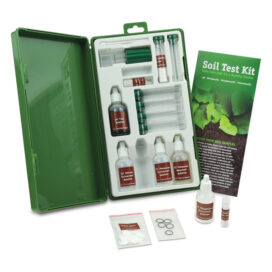
| Example | Soil test kit N, P, K, pH | 10-in-1 soil tester | – |
An electronic NPK meter is quick and easy: push it in, read it, done, without chemicals. You immediately see where in your garden or pot nutrient levels are higher or lower. If you want to know exactly how much of each nutrient is in the soil, use a soil test kit and follow the instructions precisely, because simple kits can otherwise differ quite a bit from the laboratory (Montana State University). For full fertiliser advice, have the soil tested by a laboratory.
NPK soil test in 4 steps
- Sample at root depth. For a lawn to 7.5 cm (3 in), in vegetable gardens and borders to 15–20 cm (6–8 in) (Purdue University). For pot plants, take soil from the middle of the pot.
- Mix several spots. Take soil from 4 to 6 spots in a border or 10 to 15 in a larger garden and mix it (Purdue University). Remove stones and roots.
- Follow the instructions precisely. With a test kit, the amounts of soil and water and the waiting time determine the result. You can find the manuals under download manuals.
- Write it down and repeat. Test a garden every 3 to 5 years (Purdue University). Also check the soil pH, because at the wrong pH plants struggle to take up nutrients.
Keeping track of nutrients in potting mix
In pot plants, nutrient levels change faster than in the garden. An EC meter or the Fertometer is handy here: after feeding, you see whether nutrients have been added and whether they drop away again. If you see brown leaf tips, wilting or a white crust on the pot rim, there has probably been too much fertiliser (University of Connecticut). Flush the pot well with water.
Our picks for an NPK soil test



Frequently asked questions about NPK soil tests
NPK soil test
What does NPK mean?
NPK stands for the three main plant nutrients: nitrogen (N), phosphorus (P) and potassium (K). On a fertiliser pack you see the ratio, for example 10-5-15.
How do you test NPK in soil?
With a soil test kit: you mix a soil sample with water and a reagent and compare the colour with a chart. An electronic NPK meter is pushed straight into the soil. The most accurate option is a laboratory soil test (Montana State University).
How reliable is an electronic NPK meter?
An electronic NPK meter gives a quick indication and is handy for comparing spots. For exact values per nutrient and full fertiliser advice, use a soil test kit or have the soil tested by a laboratory.
Is a soil test kit reliable?
It depends on the kit. In a comparison, simple kits differed moderately to strongly from the laboratory; the best kit, where you dry and grind the soil, came close to lab values (Montana State University). So follow the instructions precisely.
Spotting deficiencies
What does nitrogen deficiency look like?
General yellowing of the older, lower leaves, while the rest of the plant is light green (University of Arizona).
What does potassium deficiency look like?
Older leaves wilt and look scorched, with yellowing between the veins that moves inward from the leaf edge (University of Arizona).
What does phosphorus deficiency look like?
Leaf tips look burnt, and then older leaves turn dark green to reddish-purple (University of Arizona).
Soil sample and laboratory
How do you take a soil sample?
For a lawn, sample to 7.5 cm (3 in); in vegetable gardens and beds, to 15–20 cm (6–8 in). Take soil from several spots and mix it: 4 to 6 spots in a border, 10 to 15 in a larger garden (Purdue University).
How often should you test your soil?
For a garden, every 3 to 5 years is enough (Purdue University). Pot plants use up nutrients faster; track them with an EC meter after feeding.
When should you have soil tested by a lab?
When you want exact fertiliser advice, for a large vegetable garden, or when plants keep struggling even though you feed them. A laboratory measures each nutrient separately and gives advice (Montana State University).
Measuring in water too? Read about the EC of water. Everything about feeding and EC is under EC meter for plants.
Not sure which meter suits you?
Tell us what you want to measure: pot plants, vegetable garden or lawn. We’ll help you choose the right test kit or meter, free of charge.
Sources
- Bradley & Hosier, Guide to Symptoms of Plant Nutrient Deficiencies, University of Arizona: spotting deficiencies on the leaves
- Soil test kits vs. laboratory tests (2019), Montana State University: test kits compared with the laboratory
- Daniel, Lerner & Ackerson, Collecting Soil Samples for Testing (HO-71), Purdue University: taking a soil sample and how often to test
- Pettinelli, Fertilizing Houseplants, University of Connecticut: feeding pot plants, signs of too much fertiliser
- Soil Electrical Conductivity, USDA NRCS: what an EC meter does and does not measure
Last updated: 10 November 2026