
 2.svg)



EC of water: how much nutrient is in your water?
The EC of water tells you how many dissolved salts and nutrients it contains. Here you’ll find the EC of tap water, the right EC for watering plants and hydroponics, and how to mix and measure a nutrient solution.
What does the EC of water tell you?
The EC of water shows how many dissolved salts it contains. Pure water hardly conducts electricity; add fertiliser and the EC rises. So with an EC meter you can see straight away how much nutrient is in your water or nutrient solution. However, the meter does not tell you which nutrient it is (USDA NRCS).
EC is usually given in mS/cm, where 1 mS/cm equals 1000 µS/cm (UMass Amherst). Water suppliers often use mS/m; divide that by 100 for mS/cm. A TDS meter shows the same in ppm, converted with a factor of 500 or 700 (Bluelab).
EC of water: chart
| Type of water | EC (mS/cm) | Source |
|---|---|---|
| Tap water, EU legal maximum (at 20 °C) | 2.5 | EU Directive 98/83/EC |
| Tap water Amsterdam (average 2025) | 0.53 | Waternet |
| Water for plants, without fertiliser | 0 – 1.5 | UMass Amherst |
| Water for seedlings and cuttings | below 1.0 | UMass Amherst |
| Water for plants, with fertiliser | usually 1.5 – 2.5 | UMass Amherst |
EC of water for hydroponics by crop
| Crop | EC (mS/cm) | pH |
|---|---|---|
| Tomato | 2.0 – 4.0 | 6.0 – 6.5 |
| Lettuce | 1.2 – 1.8 | 6.0 – 7.0 |
| Pepper | 0.8 – 1.8 | 5.5 – 6.0 |
| Cucumber | 1.7 – 2.0 | 5.0 – 5.5 |
Mixing a nutrient solution: the EC of water step by step
- Measure your water first. Note the EC of the tap water or rainwater you use. That is your starting point, because tap water already contains salts.
- Add fertiliser and stir. Dose according to the label of your hydroponic nutrient and stir well.
- Adjust the EC. If the EC is too high, dilute with water; if it is too low, add a little concentrate. Stir and measure again (Oklahoma State University).
- Then measure the pH. Only adjust the pH once the EC is right (Oklahoma State University). Read how to test the pH of water.
- Check daily. Measure EC and pH every day at the same time. Keep the water preferably at 22 to 24 °C (Oklahoma State University).
How to measure the EC of water in 4 steps
- Calibrate the meter. Use calibration solution of 1.41 mS/cm (1413 µS/cm), stir and wait until the reading is stable (Oklahoma State University).
- Take a sample. Pour water or nutrient solution into a clean cup.
- Mind the temperature. Cold water gives a lower EC, about 2 percent per degree (USDA NRCS). Use a meter with automatic temperature compensation, or always measure at the same temperature.
- Read and rinse. Stir briefly, read once the value is stable and rinse the electrode afterwards. You can find the manuals for our meters under download manuals.
EC meter, TDS meter or EC and pH set?
| EC meter | TDS meter | EC and pH meter set | |
|---|---|---|---|
| Shows | EC in mS/cm or µS/cm | TDS in ppm | EC, TDS, pH and temperature |
| Actually measures | Conductivity | Conductivity, converted | Conductivity and acidity |
| Note | – | Factor 500 or 700 differs per brand | – |
| Best for | Watering and feeding plants | Drinking water and aquarium | Hydroponics |
| Example | EC meter for liquids | – | EC and pH meter set |
For plants, an EC meter is the most practical: all fertiliser charts and advice use EC, so you don’t need to know which ppm scale your meter uses. If you grow hydroponically, you also measure pH, and the EC and pH meter set is the best choice.
Our picks to measure the EC of water
-
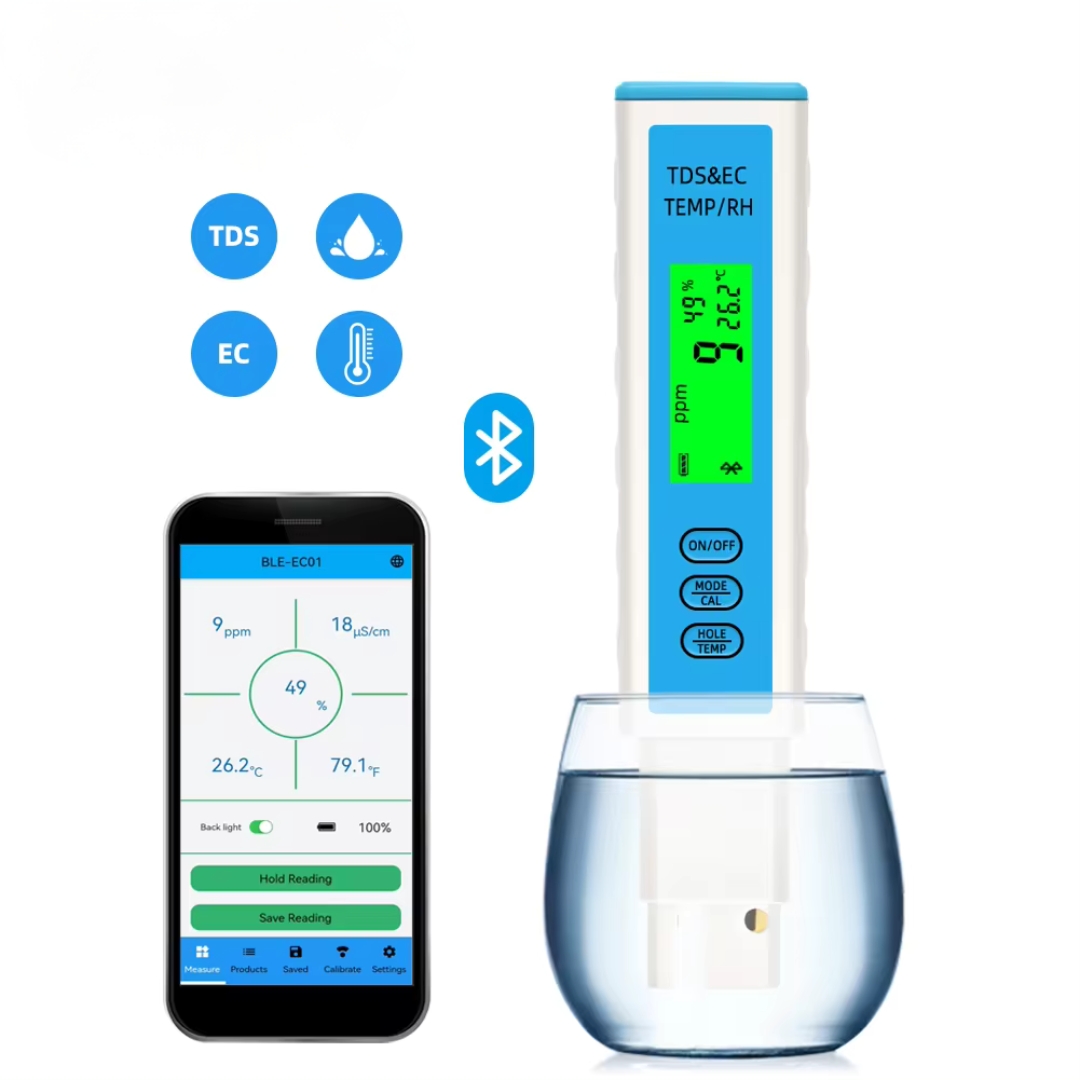
 EC and pH meter with BluetoothOriginal price was: €49,95.€39,95Current price is: €39,95.
-
 EC – Liquid conductivity meter with Bluetooth€16,90
-
 pH – Acidity meter for liquids with Bluetooth€16,90
Frequently asked questions about the EC of water
EC of tap water
What is the EC of tap water?
In the EU, drinking water may have a conductivity of up to 2500 µS/cm at 20 °C, which is 2.5 mS/cm (EU Drinking Water Directive). Actual values are usually much lower: Amsterdam tap water averaged about 0.53 mS/cm in 2025 (Waternet). Your water supplier publishes the value for your area.
What is the difference between EC and TDS?
EC is the measured conductivity of the water. TDS (total dissolved solids, in ppm) is a conversion of that EC with a fixed factor, usually 500 or 700 (Bluelab). A TDS meter also measures conductivity, but shows a different number.
How many ppm is an EC of 1.0?
An EC of 1.0 mS/cm is 500 ppm on the 500 scale and 700 ppm on the 700 scale (Bluelab). Check your manual for the scale your meter uses, or simply work with EC.
How do I convert µS/cm and mS/m to mS/cm?
1 mS/cm equals 1000 µS/cm (UMass Amherst), so divide µS/cm by 1000. Water suppliers often use mS/m; divide that by 100. For example, 52.8 mS/m is 0.528 mS/cm.
Right EC values
What EC should water for plants have?
Water without fertiliser is best at an EC of 0 to 1.5 mS/cm; for seedlings and cuttings preferably below 1.0. With fertiliser added, EC is usually between 1.5 and 2.5 mS/cm (UMass Amherst).
What is a good EC for hydroponics?
It depends on the crop: lettuce 1.2–1.8 mS/cm, pepper 0.8–1.8, cucumber 1.7–2.0 and tomato 2.0–4.0 (Oklahoma State University).
Does temperature affect EC?
Yes. The colder the water, the lower the EC: about 2 percent per degree (USDA NRCS). So use a meter with automatic temperature compensation, or always measure at the same water temperature.
Adjusting the EC of water
How do you lower the EC of a nutrient solution?
Dilute the solution with water, stir and measure again until the EC is right (Oklahoma State University).
How do you raise the EC of a nutrient solution?
Add a little nutrient concentrate, stir and measure again (Oklahoma State University). Work in small steps so you don’t overshoot.
Should you measure EC or pH first?
EC first. Get the EC right, then measure the pH, because adding fertiliser changes the pH (Oklahoma State University).
Want to know more? Read about the EC meter for plants, how to measure nutrients in soil and how to test the pH of water.
More from the knowledge base
Not sure which meter you need?
Tell us what you want to measure: tap water, rainwater or your hydroponic nutrient solution. We’ll help you choose the right EC or pH meter, free of charge.
Sources
- Singh & Dunn, Electrical Conductivity and pH Guide for Hydroponics, Oklahoma State University: EC by crop, adjusting nutrient solution, calibration
- Water Quality for Crop Production, UMass Amherst: EC of water for plants, with and without fertiliser
- EU Drinking Water Directive 98/83/EC, Annex I Part C: conductivity limit for tap water
- Waternet, Drinking water quality Leiduin 2025: example of tap water conductivity
- Bluelab, What are the different conductivity scales?: converting EC to ppm and TDS
- Soil Electrical Conductivity, USDA NRCS: effect of temperature on EC
Last updated: 10 November 2026